When Treatment Ends, a New Journey Begins: What Comes After Breast Cancer
Dr. Corinne Ellsworth-Beaumont and Dr. Eleonora Teplinsky on survivorship, patient education, and the questions that don't get asked in the exam room
By: Aryana Hadjimohammadi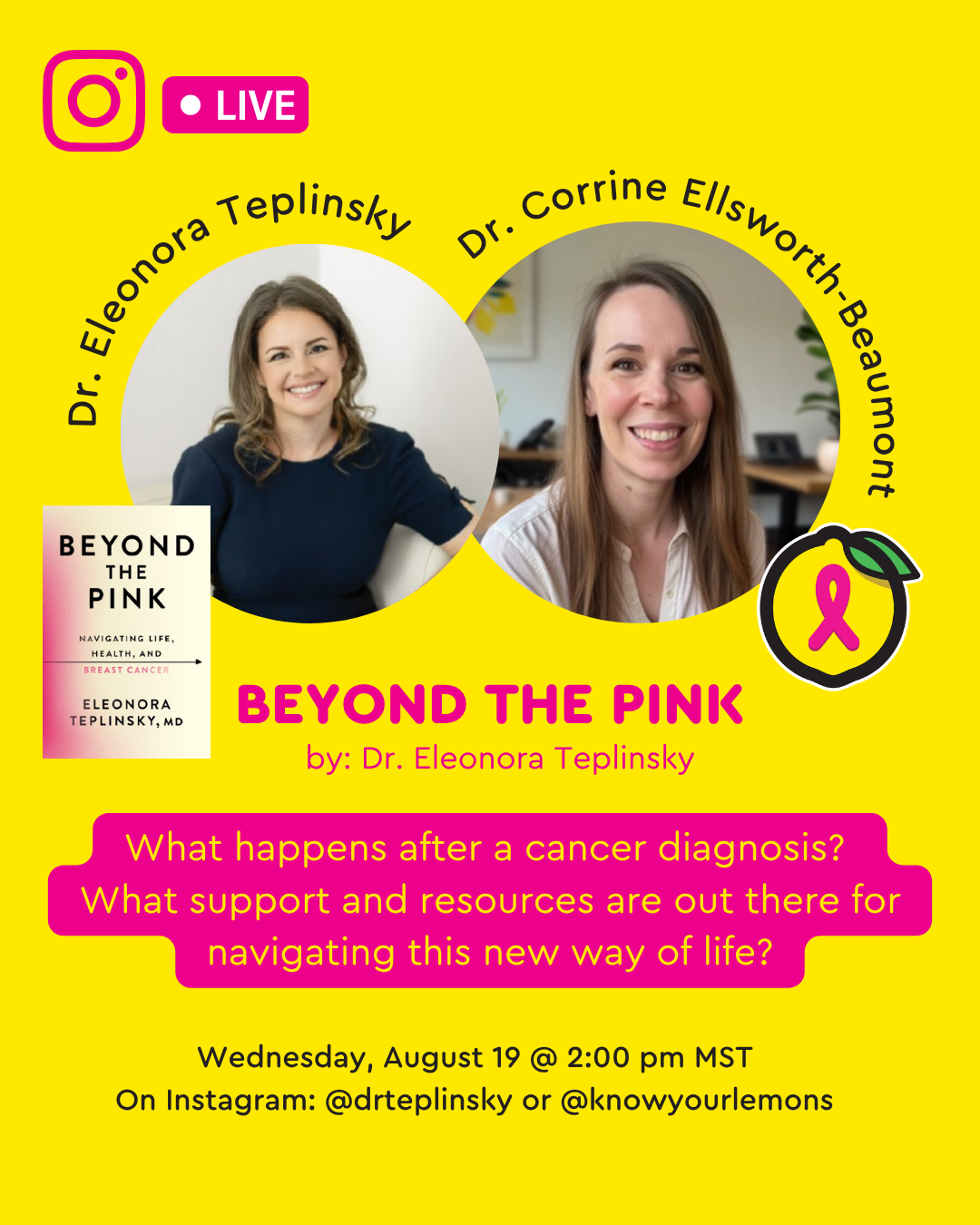
Social media announcement on the LIVE discussion with Dr. Teplinsky and Dr. Ellsworth-Beaumont
If you've ever sat in a doctor's office, you know the feeling. The clock is ticking. You have so many questions, but the visit is almost over. You leave with a treatment plan, maybe a prescription, and a head full of things you wish you'd asked.
Now imagine that feeling multiplied by a cancer diagnosis.
Dr. Eleonora Teplinsky knows this reality intimately. As a board-certified medical oncologist and the Head of Breast and Gynecologic Medical Oncology at Valley-Mount Sinai Comprehensive Cancer Care, she sees it every single day.
"I struggle with this every single day when I see patients," she said. "I have 15 to 20 minutes to spend with somebody and so often I will leave that visit and I wish we had time to talk about A, B, C and D. We just don't."
That gap—between what can be covered in a rushed appointment and what patients need to know—is exactly what inspired Dr. Teplinsky to write her new book, Beyond the Pink: Navigating Life, Health and Breast Cancer.
It’s exactly why Dr. Corinne Ellsworth-Beaumont, founder and CEO of the Know Your Lemons Foundation, invited her for this conversation. Because when patients are educated, they don't just survive—they thrive.
The Moment She Realized She Didn't Really Know
Dr. Teplinsky didn't start out as a social media educator. She started, like many oncologists, focused on the science, the medicine, the protocols. But something shifted about a decade ago when she began seeing other doctors on social media and thought, "I think I can do this."
At first, it was simple. A post about calcium and vitamin D for bone health. Then she started getting questions—lots of them.
"I'm getting a lot of questions in clinic and I don't always have enough time to answer all of them," she recalled. "And I'm sure if someone's asking, someone else has this question."
But the real turning point came when she started truly listening.
"I found that I didn't really understand what it was like to live with a cancer diagnosis," Dr. Teplinsky said. "The topics of mental health, sexual health, navigating skin anxiety and fear of recurrence and the life-changing effects of the cancer diagnosis. I knew about it but I didn't really understand it."
That honesty is striking coming from a physician. She knew the clinical facts. But the lived experience? That was something else entirely.
"It was only when I started really listening to what people were saying," she explained. "The questions people were asking. At the same time the community was growing online. Advocates were really starting to share their stories, their experiences and so as I listen more I realized, okay, there's a lot I don't know."
That realization changed everything. She started a podcast. She kept listening. She kept learning.
"I truly think it's made me such a better doctor," Dr. Teplinsky said, "because I understand a little bit more about what that lived is really like for so many people."
The Questions That Don't Get Asked in 15 Minutes
Watching Dr. Teplinsky translate that understanding into something useful for patients is what first caught Dr. Ellsworth-Beaumont's attention.
She's been following Dr. Teplinsky's work for years and knows the value of what she's putting out into the world—especially the way she translates complex medical information into something people can use.
"I appreciate you taking the time for instance after ASCO and saying, hey, this is what this stuff means," Dr. Ellsworth-Beaumont told her. "ASCO is its own language. Being able to look at those charts and then people are clapping and you're like; okay I don't know what that is."
ASCO—the American Society of Clinical Oncology—is where the world's leading cancer experts share their latest research. It's also, for most people, completely indecipherable. Dr. Teplinsky's gift is translating that into something real.
"I think you just being so generous with your time and using your talent to say actually I'm pretty good at explaining this to other people and I'm going to take the time to do that," Dr. Ellsworth-Beaumont said. "I personally just really appreciate whatever you do."
The summaries after big conferences. The posts that cut through the noise when something hits the news. The voice that says: here's where there's some factual basis and here's where it's being misinterpreted.
"Here's what this means for you," Dr. Ellsworth-Beaumont added, "which I think is the important thing because there's so much information out there swirling around."
From Social Media to a Book
All of that work on social media eventually led to a question: why stop at posts when a book could hold everything in one place?
For Dr. Teplinsky, the answer came from two places.
First: she loves books. "I'm a reader. I have floor to ceiling bookshelves in my house. I love everything about books," she said. "I've always wanted—a huge dream of mine for a long time has always been to be an author."
But the practical reason was just as important. Social media is great for reaching people in the moment. But it's not a great archive.
"People would start messaging me and be like, 'I know you had a video on this like a year ago, can you send it to me? I can't find it,'" she explained. "Social media is fantastic but there's not a great archive. You got to kind of go digging for things."
And then there were the patients coming to her with the same question repeatedly.
"Alright, I'm done with treatment. Now, what? What do I do now? What is survivorship mean? What should I be doing?"
That question—the now what—is at the heart of Beyond the Pink.
"My goal with the book was really to focus on those things," Dr. Teplinsky said. "There is stuff about diagnosis and treatment but treatment changes so rapidly and it's so nuanced that I kind of gave more of an overview."
The real focus? The areas where patients often find themselves without guidance.
"Those are in those areas of sexual health and mental health and cardiovascular health."
Evidence, Not Opinion
But a book is only as good as the information inside it. And that's where Dr. Teplinsky made a deliberate choice.
"One of the things I'm really proud of—but one of the things that I felt really strongly about—was that everything has evidence and so if there's no evidence, I say that," Dr. Teplinsky explained. "We don't know this. Here's what the thoughts are."
The book has about 400 references. Everything is meticulously cited.
"If you are reading something in the book and you're like, 'I want to learn more about the study. I want to show my doctor,' you can reference that very easily and pull out the study."
That's not just about being thorough. It's about empowerment.
"I'm hopeful that it will help people really advocate for themselves as they go in and say, 'I need a bone density scan. Here's the data. Here are the guidelines that say I should get a bone density scan. Here are the lines and say it should be on vaginal estrogen.' And really empower themselves."
At the end of each chapter? Action steps. A list of things you can do.
"You can really make a list for yourself of like these are the things they should be doing."
Even the hard chapters. Especially the hard chapters.
"In the metastatic chapter I talk about death and dying," Dr. Teplinsky said. "I really provide a lot of kind of triggers of like you can skip over this. This might be hard to read so people know it's coming—but we talk about living wills and documentation like these are things that are important to know and so there's action steps about things that everyone can take."
Survivorship Starts the Day of Diagnosis
That emphasis on practical, actionable steps is what makes the book so different from a standard medical guide. And it's also what led Dr. Teplinsky to an unexpected realization while she was editing.
"When I finished writing the book when I was going through the final edits, I was like, 'Oh my god. I don't think I have a dedicated section on survivorship. Should I have done that?'"
Then she answered her own question.
"The whole book is about how to live healthy. So, I went back and added a sentence: 'You'll notice that there isn't a dedicated section on survivorship because it starts a day of diagnosis and it's all the things that follow.'"
This is a crucial point. So many patients describe feeling abandoned after treatment ends.
Dr. Ellsworth-Beaumont has heard this story countless times.
"So many patients have said after active treatment finished and I rang that bell I felt like I was abandoned and I had no idea what to do," she said. "You try to go back to your normal life, and you realize that's not how life works. You could only go forward."
That's why a book like this matters. Because not everyone has a physician who can explain things.
"It's really a lottery when it comes to a breast cancer diagnosis of who your healthcare team is," Dr. Ellsworth-Beaumont said. "If they have the capacity to talk to you about things, if they're good at explaining stuff, if they can think ahead for you to say, 'Oh by the way this is coming up and here's how you—proactive about what's coming or here's how to handle this.'"
A book can't replace a doctor. But a book can be there when a doctor can't.
Who Is This Book For?
So, with all of that in mind, who is this book for? Dr. Teplinsky has a clear answer.
"The audience is anyone who's a previvor who's at risk for being diagnosed with breast cancer due to a strong family history or genetic mutation," she said. "It's anyone who's been diagnosed with cancer whether you're newly diagnosed or done with active treatment or living with metastatic disease."
And it's not just for patients.
"It's for family members and caregivers and friends who want to understand what you've gone through or how they can support you."
The book has fifteen chapters, and each one can be read on its own.
"Will every single chapter in the book speak to everyone? No," Dr. Teplinsky said. "If you're not living with metastatic disease, you may feel nervous about reading that chapter and you may want to read it. You may want to skip over it. If you feel like, 'I don't want to think about this topic right now because it's too much,' you can skip over that."
But there's something in there for everybody.
One review that particularly moved her came from someone who said the book is a great resource for caregivers—even though she hadn't intended it that way.
"I had a whole chapter on caregiver support and we just had no space and so we made the decision to kind of cut that," Dr. Teplinsky explained. "One of the reviews said, 'This is such a good resource for caregivers to truly understand what the loved one went through.' That was very meaningful to me because I'm glad that it's kind of like an unintended thing that happened."
The Fear of Knowing Your Risk
Of course, knowing what to do after diagnosis is only part of the picture. For many people, the fear starts even earlier—before a diagnosis ever happens.
At Know Your Lemons, one of the tools they offer is the Tyrer-Cuzick risk assessment—a way for people to understand their breast cancer risk and what their screening plan should be according to the National Comprehensive Cancer Network (NCCN) Clinical Practice Guidelines in Oncology. The NCCN is the leading authority that establishes the standard of care (SOC) for cancer screening, diagnosis, and treatment in the United States, with guidelines that are updated regularly based on the latest evidence.
But Dr. Ellsworth-Beaumont has noticed something: some people don't want to take it.
"Sometimes when we're telling people about the app and that we have this feature they say, 'Oh I don't want to know like I'm too nervous to do the risk assessment,'" she shared. "What do you say to people who are nervous about understanding what their risk is for breast cancer?"
Dr. Teplinsky has heard this too.
"I think this is a common question. I see it and hear it all the time," she said. "We're like, 'No I don't want to know.' And I understand that. I think that is really a real concern and validating."
But she gently pushes back.
"I think of it as information, it's empowerment," she said. "If you know you're at higher risk, it doesn't mean you're going to be diagnosed but it means we can now take steps to get supplemental imaging, that we can think a little bit better about where we can lower risk."
She acknowledges that the Tyrer-Cuzick isn't perfect. But she's clear about one thing.
"Ignorance here is not bliss."
"I see a lot of people who were high risk and didn't know and they say, 'Oh I wish I had known. I wish I was at least more aware that this could happen.'"
Her advice? Before you take the assessment, name your fear.
"What am I nervous about? And what am I going to do with that information? A lot of times people say, 'I don't want to know because I don't want to live in fear.' But I think with the Tyrer-Cuzick we can actually make a plan."
Dr. Ellsworth-Beaumont agrees.
"Fear really thrives in spaces where you're in unknown territory," she said. "Because you have so little information and so being able to have more information can create a plan that can reduce that unknown which can reduce the fear because you're educated."
"Being told you have a higher risk for getting breast cancer doesn't mean you will get it," she added. "It means now we know to give you more resources."
How to Spot Misinformation Online
That emphasis on education and information is especially important right now, when it seems like everyone online has an opinion about cancer.
If there's one thing both doctors want you to know, it's this: not everyone on social media is in it for the right reasons.
Dr. Ellsworth-Beaumont sees it constantly.
"On social media, there's so many people who are willing to tell you that they're an expert," she said. "They have the sure answers of, 'You know this absolutely is going to change everything for you and by the way you can pay for the thing I'm selling in my bio.'"
Dr. Teplinsky nodded. "Anyone can call themselves an expert and I will say I've fallen for it too. It's hard to find people's credentials."
So how do you tell the difference between genuine expertise and someone trying to sell you something?
Dr. Ellsworth-Beaumont has a simple rule: look at what they're selling.
"When you see that those messages come across Instagram, a good thing is to look to see what they are selling you," she said. "Usually what they're trying to do is take away the resources for you. So, the only solution left is the one that they're making money from."
She gave an example: "They're like, 'Mammograms don't work so I want you to use my tool instead.' Or, 'This happens so I want you to buy my book about smoothies.'"
Dr. Ellsworth-Beaumont has a translation for that kind of messaging.
"When you hear that phrase—'here's what your doctor doesn't want you to know'—you can replace it with, instead of 'here's information your doctor doesn't want to know,' it should be 'I have something to sell you and I want your money.'"
Dr. Teplinsky laughed. "That's the real phrase."
The Bra Myth and Other Nonsense
Misinformation isn't just about people selling supplements or smoothies. Sometimes it's about things that seem completely ordinary—like bras.
Dr. Teplinsky shares a story that perfectly illustrates how misinformation spreads.
"I saw recently something about how if you wear a bra most of the day you have a 78 percent chance of getting breast cancer," she said. "So, I commented on it and I said, 'I'm a medical oncologist and this is blatant misinformation. Here's why. Here is the study that showed that the amount of time you wear a bra has no correlation with breast cancer risk.'"
The study was from 2014. She cited it. People liked her comment. They agreed.
"A lot of people were like, 'How could you just go by one study? You need many studies to prove your point,'" Dr. Teplinsky recalled. "Except the person who was saying that bras increase breast cancer had no studies to back up his point."
She paused. "I was like, okay, and that doesn't make sense. He was pointing to some book that had no date."
The post had thousands of likes.
"Wear a bra, don't wear a bra, and you do whatever, you do you," Dr. Teplinsky said. "But it's not going to cause breast cancer."
Dr. Ellsworth-Beaumont has seen similar nonsense. A company reached out to her this week about promoting a product.
"They're like, 'Hey you're a charity. People trust you. Will you like support this?' And we're like, 'No. Because it doesn't show us the randomized control trial on this.' 'Oh well we're working on it.' 'Great. When it's done let us know. I'm happy to review it at that point.'"
Why Preorders Matter
With all that misinformation out there, getting trustworthy voices into the world matters more than ever. And that's where preorders come in.
Dr. Teplinsky is new to the publishing world, and she's learned something surprising: preorders matter more than she expected.
"Preorders I've been told really make a big difference," she said. "We're in a world where people don't preorder as much because we all like instant gratification—like I ordered, I wanted it to come tomorrow. But preorders really tell bookstores and reviewers and libraries that this topic—not even my book but like this topic matters."
She shares the backstory.
"When I was signed with my agent, we were trying to get a book deal. A number of editors said, 'We love the topic. Well, we don't think it has a market. We don't think people are going to buy a book about breast cancer.'"
Dr. Teplinsky didn't agree.
"I was like, 'I don't agree with you. I think people will buy a book about breast cancer because there are 300,000 people diagnosed each year with breast cancer. We're looking for more information.'"
Her goal isn't just to sell books. It's to get the topic out there.
"Get people talking about this," she said. "Validate that these are important conversations to have. I think so often we hear about breast cancer in the news when a celebrity is diagnosed and it's scary. What I'm trying to do is really debunk that and talk about topics that are important."
She wants to see sexual health in the news. Mental health and cancer. These topics deserve space.
"I want this topic to be on shelves at bookstores."
Dr. Ellsworth-Beaumont is on board.
"You are in this for the right reasons and we need to elevate expert voices with the era that we're in," she said. "I love that you talk about how preordering is important because this is sending a message that this topic is important and it needs to be shared and elevated and people understand just how important it is."
Lift As We Rise
At the end of the conversation, the two women circled back to what really matters: community, support, and rising together.
Dr. Teplinsky smiled. "My favorite saying: lift as we rise."
Dr. Ellsworth-Beaumont echoed it. "Let's lift women together."
That's what this is about. Not just surviving breast cancer—but rising together. Sharing what we know. Listening to each other. Making sure no one must navigate this alone.
Because when patients are educated, outcomes are better. When we know what to ask for, we can advocate for ourselves. When we have resources like Beyond the Pink—and organizations like Know Your Lemons—we don't have to figure it all out in a 15-minute appointment.
We can keep learning. Keep asking. Keep rising.
Preorder Beyond the Pink
Dr. Eleonora Teplinsky's book, Beyond the Pink: Navigating Life, Health and Breast Cancer, releases September 29, 2026. It is available for preorder wherever books are sold, including:
Ask your local bookstore to carry it
Request your local library to stock it
Learn More
Know Your Lemons Foundation – A global charity dedicated to early detection of breast cancer through creative, accessible education. Their free app was named the Best Health & Fitness App at the 2025 Webby Awards. Visit knowyourlemons.org to learn more, take the Tyrer-Cuzick risk assessment, and access educational resources in over 40 languages.
Dr. Eleonora Teplinsky, MD – Board-certified medical oncologist and Head of Breast and Gynecologic Medical Oncology at Valley-Mount Sinai Comprehensive Cancer Care. Follow her on social media for evidence-based education on breast and gynecologic cancers.
Valley-Mount Sinai Comprehensive Cancer Care – Providing comprehensive cancer care in Paramus, New Jersey. Visit valleyhealth.com for more information.